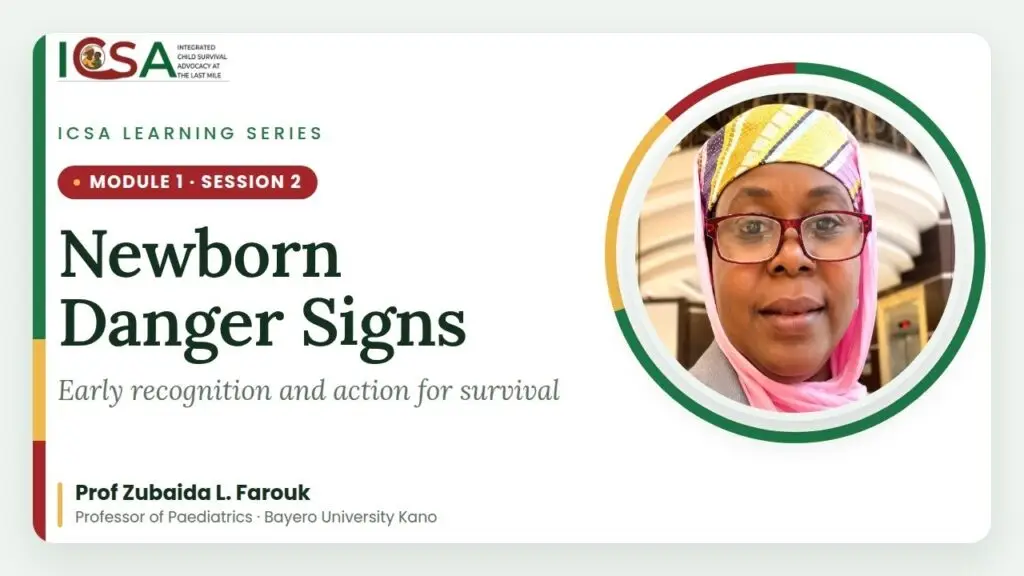
ICSA Learning Series: Newborn Danger Signs: Early Recognition and Action for Survival

Newborn Danger Signs: Early Recognition and Action for Survival

A sick newborn can deteriorate in hours. Knowing the danger signs, and acting on them at the first facility or community contact, is one of the most powerful things a PHC worker can do.
Summary and key messages

A sick newborn can deteriorate in hours. Knowing the danger signs, and acting on them at the first facility or community contact, is one of the most powerful things a PHC worker can do.

What this session covers

  • Identifying key newborn danger signs during facility and community contacts
  • Prioritising urgent cases with a systematic triage approach
  • First-line management for sick newborns at PHC level
  • Counselling caregivers on when and where to seek care
  • Strengthening referral and follow-up for high-risk newborns

Facilitator

Prof Zubaida L. Farouk, Professor of Paediatrics, Bayero University Kano.

Part of the ICSA Learning Series, Module 1: Essential Newborn Care. Participants who attend the required share of Module 1 sessions and complete the pre- and post-session assessments earn a certificate of participation.

Licence: Slides © the facilitator · shared by ICSA for educational use · Cite ICSA and the publication date when you reuse this material.
Related

Related resources

Video
All ICSA states · English · 25 pages
About one in ten newborns needs help to start breathing. In a primary health centre the person in the room is often the only skilled attendant. This session is about being ready for that moment.
Video
All ICSA states · English · 22 pages
Birth asphyxia, a baby failing to start or keep breathing at birth, is one of the leading causes of newborn death, and the burden falls heavily on primary health centres. Most affected babies need only simple, timely steps.
Video
All ICSA states · English · 30 pages
Nigeria has one of the highest numbers of preterm births in the world, and many small babies die within days of problems that are preventable with warmth, feeding and timely referral.